Visual Diversity: Finding Out What Looks Good
You may have heard the design maxim that the most preferred designs are visually neither too simple, nor too complex—but is that true?

You may have heard the design maxim that the most preferred designs are visually neither too simple, nor too complex—but is that true?
Health-related behaviors, like many others, can be influenced by the physical environment. This book’s aim is to elucidate the connection.
In today’s urban environments, sound reduction often can make outdoor spaces more comfortable for people. One method is to block sound through dense vegetation to reduce sound spillover.
What influence does urban design have on human health at the scale of individual buildings and surroundings, neighborhoods, and towns and regions? Laura Jackson (National Health and Environmental Effects Research Laboratory, EPA) surveyed the literature.
One of the often-touted goals of neotraditional neighborhood design is to create a more pedestrian-friendly environment—one where residents walk and bike to local attractions, rather than drive. Several recent studies look at how people’s actions may support or hinder those aims.
Anyone who has sought out a choice spot under a tree on a hot day knows that a single tree can create its own microclimate. In small, tree-rich urban parks, the effect can be significant.
Individuals traversing urban areas move in as straight a line as possible—even if that route requires grade changes.
The important point here is how pedestrians can be generated in an environment around a catalyst.
Neal Kumar Katyal of the Georgetown University Law Center breaks that mind-set and reviews in detail several effective design strategies to reduce crime.
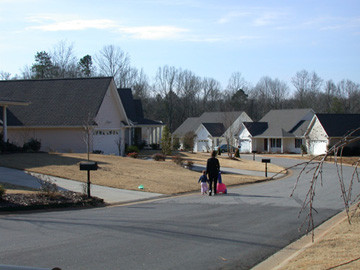
One of the feature articles in our last issue (October 2002, p. 1) covered two studies on walking behavior and neighborhood aesthetics. Three more studies also conclude that neighborhood design affects who walks, and how often then walk.